



Electric riding promises a wonderfully simple thing: more possibilities in the time you already have. A commute can feel less daunting. A weekend outing can cover more ground. A short errand can become an enjoyable ride. But choosing the right machine is not as simple as selecting the biggest motor or the longest advertised range. An electric dirt bike, a pedal-assist commuter, a folding e-bike and a three-wheel utility model solve very different problems.
That variety is what makes QRONGE electric bikes and dirt bikes worth exploring. The brand’s current catalog includes the compact X1 Spark M and larger X1 Spark L off-road machines, pedal-equipped e-bikes such as the Zephyr and folding Mirage, and the Lava electric tricycle. Rather than pretending these products are interchangeable, this guide helps you match a QRONGE model family to your actual route, storage space, riding experience and local rules.
This is a researched shopping guide, not a hands-on road test. Specifications and policies were checked against the retailer’s site on September 23, 2026. Listings, stock, prices and terms can change, and a seller’s range or performance claims are not independent test results. Use the linked product pages and official policies as the final authority before buying.
Affiliate disclosure: This article contains affiliate links. If you purchase through them, the publisher may earn a commission at no additional cost to you. We do not claim to have personally tested these bikes.
Start exploring: Browse QRONGE’s current electric bikes and dirt bikes through our shopping link.
Contents
- The QRONGE lineup at a glance
- Electric dirt bike or commuter e-bike?
- X1 Spark M and X1 Spark L
- Zephyr and other commuter choices
- Mirage folding e-bike
- Lava electric tricycle
- How to evaluate range and power
- Fit, handling and storage
- Safety and where to ride
- Ordering and ownership
- FAQs
The QRONGE Lineup at a Glance
The fastest way to understand the catalog is by intended use, not by the word “electric.” QRONGE’s official comparison page lists models spanning compact off-road riding, city-oriented e-bikes, folding designs and a tricycle. That breadth is a genuine shopping advantage: a buyer can begin with the daily activity they want to improve and compare several approaches in one place.
| If your main goal is… | Start by exploring… | The important question |
|---|---|---|
| Recreational riding in a legally permitted motorized area | X1 Spark M or X1 Spark L | Is the terrain and venue open to this type of motorized vehicle? |
| A familiar two-wheel bicycle format for everyday trips | Zephyr or another pedal-equipped e-bike | Does the exact configuration meet your local e-bike rules? |
| A bike that can be stored in a smaller space | Mirage folding e-bike | Can you comfortably lift, fold and store its actual weight and dimensions? |
| Short errands with a basket and three-wheel layout | Lava electric tricycle | Is your route wide and smooth enough, and does the trike fit your storage area? |
The table is a starting point, not a legal classification or performance guarantee. Some listings use “e-bike” as a broad marketing term even when a vehicle’s speed, power or lack of pedals makes it very different from a conventional low-speed electric bicycle. The actual model, its configuration and the rules in the places you plan to ride determine what is appropriate.
Electric Dirt Bike or Commuter E-Bike?
The distinction is more consequential than it looks in a product grid. A commuter e-bike generally starts with the familiar bicycle experience: operable pedals, a saddle and controls designed for everyday transportation. A dirt bike is designed around powered off-road performance and may have very different controls, speed potential, tires and legal access. A throttle-equipped model is not automatically street-legal, and a compact shape is not evidence that it belongs on a bicycle path.
Ask yourself where the machine will spend most of its time. If the answer is paved roads, bike lanes and errands, begin with a pedal-equipped model and confirm the class, motor rating, assisted-speed behavior, throttle arrangement and local requirements. If the answer is a private practice area or designated motorized trail, examine the X1 Spark family and the rules of the venue. If the answer is “both,” do not assume one model can lawfully cover both settings.
The U.S. Bureau of Land Management’s e-bike FAQ illustrates why definitions matter. Its rule describes qualifying e-bikes with fully operable pedals and a motor of no more than 750 watts, divided into Classes 1, 2 and 3 by how assistance works and when it stops. That federal-land definition is not a universal permission slip for every road, state or trail. Site-specific land managers make access decisions, and higher-powered electric dirt bikes should not be presumed to qualify as low-speed bicycles.
This is not merely fine print. Choosing a bike for a route on which you cannot ride it would turn an exciting purchase into a frustrating one. Confirm the route and applicable rules before selecting the model—not after delivery.
QRONGE X1 Spark M and X1 Spark L: Off-Road Options
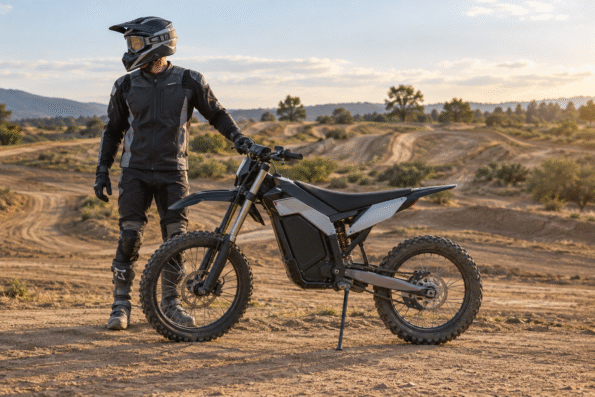
The X1 Spark M and X1 Spark L are the most obvious choices for someone drawn to QRONGE’s off-road side. On the brand’s comparison page, the X1 Spark M is described as a compact electric mini bike, while the X1 Spark L has a larger stance and different wheel sizes. The site advertises 4,500 W peak motor power for these models. That is a marketing specification for peak output; it should not be confused with a continuous motor rating or with proof of eligibility for bicycle infrastructure.
Who the X1 Spark M may suit
The smaller X1 Spark M makes sense to investigate when a compact off-road platform and rider fit are priorities. The comparison page gives recommended rider-height information for the M, along with battery, wheel, suspension and load figures. Check the latest listing and manual rather than assuming the word “mini” means it is a toy or automatically appropriate for a child. A powered machine with substantial acceleration demands adult judgment, correct safety equipment, supervision appropriate to the rider and a legal place to operate.
Who the X1 Spark L may suit
The L is worth considering if a larger stance and wheel arrangement are a better match for the rider and the terrain. QRONGE describes the L as using a 17-inch front and 14-inch rear tire configuration in its current catalog. Wheel diameter affects how a bike rolls over obstacles, but it does not replace good technique or protective gear. Braking setup, suspension adjustment, tire condition and rider experience all matter.
Performance claims need context
QRONGE’s listings may display a top-speed or maximum-range figure for an X1 Spark variant. Those numbers are not promises for every rider or surface. Elevation, temperature, riding mode, tire pressure, rider and cargo weight, stops, throttle use and terrain affect actual results. Treat the claimed maximum as a comparison point under unspecified favorable conditions unless the seller provides a reproducible test method.
Begin at low speed in a permitted area, read the manual and inspect tires and brakes before riding. Budget for a full-face helmet, eye protection, gloves, protective clothing and sturdy boots. No spec sheet replaces training and judgment.
The access question comes first
An off-road-capable bike does not grant universal trail access. Some public lands allow motorized use only on designated routes; other places have stricter restrictions. Private land requires the owner’s permission. Check the latest rules for your exact destination and vehicle before loading up. A local riding club or land manager may help identify designated areas, but get the actual authorization from the relevant authority.
If off-road exploration is your real goal, compare QRONGE’s current X1 Spark listings after confirming where you can ride.
The Zephyr and the Everyday Commute
Not every rider wants a dirt bike. For many people, the appeal of electric assistance is much simpler: arriving at work with less effort, enjoying a longer route home or feeling more confident about moderate hills. QRONGE positions the Zephyr as a city-oriented e-bike with full suspension and advertises 1,000 W peak power on its main catalog. “Peak” is the key word here, and local classification may depend on other specifications and configuration. Confirm the actual legal status where you live rather than deriving it from a headline number.
Suspension can make imperfect pavement feel less harsh, but it also adds components, weight and maintenance considerations. Consider the ride in its entirety. Is the route smooth enough that a simpler setup would work? Do you have secure parking? Will the bike fit through the door, around the hallway corner and into the storage area? Can you reach the ground comfortably at stops?
A commuter’s useful range should cover the round trip with margin, not merely the distance to work. Suppose your commute is nine miles each way. The daily plan is at least 18 miles, plus detours, wind, hills and the possibility of forgetting to charge. Instead of buying to an advertised range figure with no buffer, examine battery capacity, riding modes and charging access. Your confidence on the return journey matters more than the largest number on a sales page.
For a commuting comparison, create a short list of three routes: your regular weekday ride, a longer weekend ride and a wet-weather alternative. If the bike fits only the ideal sunny-day route, think carefully about whether it will be used often enough to justify the investment.
Mirage: A Folding Bike for Space-Conscious Riders

A folding e-bike is attractive when storage, mixed-mode travel or a small apartment is the limiting factor. QRONGE describes the Mirage as a quick-folding model with a 20-inch by 3.0-inch tire format. It is an appealing combination on paper: a compact storage shape paired with tires designed to offer a more substantial contact patch than a very narrow city tire.
But “folding” does not mean effortless. Before choosing the Mirage or any folding electric bike, measure the space where it will actually live. Check the folded dimensions, total weight, battery-removal procedure, handlebar position and whether the folded bike can be carried without snagging clothing or walls. Test the route from your door to storage in your mind: stairs, elevators, train platforms and car trunks are more useful measurements than a studio photograph.
Follow the manual’s folding sequence, confirm that locks engage fully and check that cables are not pinched. Never ride with an incompletely secured frame or handlebar assembly.
The Mirage can make sense for a rider who values space efficiency first but still wants a conventional bicycle-like riding experience. If you must lift a bike up several flights of stairs every day, however, weight may outweigh the benefit of folding. If you have a large garage and no mixed-mode commute, a non-folding model may be simpler. Choose the compromise that addresses your actual constraint.
Lava: Three-Wheel Utility for Everyday Errands
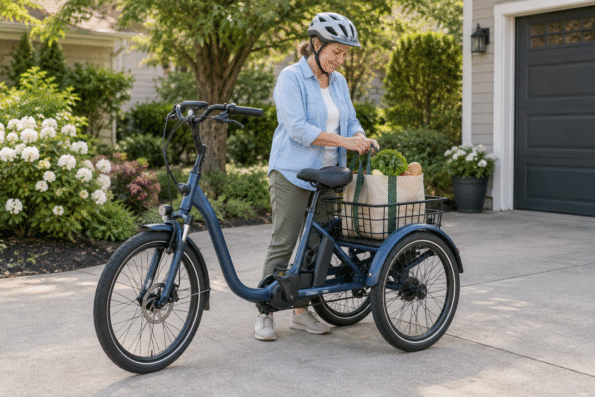
The Lava electric tricycle takes a different approach to everyday mobility: three wheels and room for practical trips. QRONGE presents it as a utility-oriented model, making it relevant for shoppers who want a basket, an upright-feeling layout or a different balance from a two-wheel bicycle. Its appeal is easy to imagine: a short grocery run, a neighborhood visit or a pleasant outing without balancing a bag on your back.
Three wheels do not mean “impossible to tip.” A tricycle handles turns differently from a bicycle, especially on cambered roads or tight corners. Learn its steering response at low speed, respect cargo limits and do not add a passenger unless the exact model is rated for one.
Storage becomes particularly important. Measure the narrowest gate, doorway and path the trike will need to pass. Consider the turning space at home and at your destination. A trike that feels convenient on the road may be difficult to maneuver through a small shed or crowded elevator. Check the tire size, braking arrangement, basket dimensions, total weight and whether the battery can be removed for charging.
How to Read Range, Power and Battery Claims
An e-bike listing can show motor watts, torque, battery volts and amp-hours, maximum speed, range, payload and charging time. These figures are useful only when you understand what they describe and what they leave out.
Peak power is not the whole ride
Peak power refers to a short-term output figure advertised by a manufacturer. It is not the same as continuous rated power, and it says little by itself about smoothness, efficiency or legal e-bike class. A more powerful machine may be appropriate for a designated motorized venue but not for a route limited to a qualifying low-speed electric bicycle. Ask the retailer which rating applies to the exact variant and what its documentation says.
Battery capacity is a comparison tool
Battery energy is commonly expressed in watt-hours (Wh). When voltage and amp-hour figures are both provided, multiplying them gives a nominal energy estimate in Wh. For example, a listed 60 V and 28.8 Ah pack corresponds arithmetically to 1,728 Wh. That does not guarantee a particular number of miles: power draw and usable energy vary with conditions and system behavior.
Range depends on the test
“Up to” range is a ceiling claim, not a commuting promise. Pedal-assist level, throttle use, acceleration, hills, wind, temperature, tire pressure, rider mass and surface all affect results. Ask whether a quoted figure was obtained with pedal assistance or throttle only, at what speed and with what load. If the conditions are not stated, plan conservatively and leave a reserve for your return trip.
Payload includes everything
The published load limit should be interpreted using the seller’s instructions. Rider, backpack, basket contents, locks and accessories may all count. Add your real-world load before buying. For a tricycle, check both total load and any separate basket or rack limits. A stronger motor does not erase a frame or brake rating.
Charging time is part of usability
Think about the daily charging window and the safe place to charge. If a full charge takes several hours, does your schedule allow it? Can you bring a removable battery indoors if the bike remains in a secure outdoor area? Verify the charger supplied with the exact product and never improvise with an unrelated charger.
Fit, Handling and Storage Questions
Fit begins before a test ride. Compare recommended rider heights with your inseam, arm reach and comfort at a stop. A low step-through frame can simplify mounting; a high saddle may help pedaling efficiency but feel intimidating when stopping. The right answer is personal and model-specific.
When possible, consider three positions: seated while pedaling, standing over the vehicle and walking it through a doorway. Can you reach the controls without stretching? Can you stabilize it at a stop? Can you push it up a mild ramp or load it into your vehicle? A heavy electric machine can be easy to ride and surprisingly hard to maneuver when powered off.
Measure your storage area, doorway, elevator and vehicle carrier. Confirm that any rack is rated for the bike’s weight and wheelbase; ordinary bicycle racks may be unsuitable for heavier e-bikes. Account for weather and theft if parking outdoors.
Finally, plan for assembly and service. QRONGE’s warranty policy recommends inspection and testing by a certified e-bike technician before the first ride and warns that improper assembly can affect responsibility for damage. Before ordering, identify a local shop willing to inspect or service the particular model. Not every bicycle shop works on high-powered electric machines, and some shops limit the batteries or brands they accept.
Safety, Batteries and Where You Can Ride
Electric assistance makes speed easy to obtain. Responsible operation makes the ride sustainable. Wear an appropriate, properly fitted helmet every time, and choose additional protective equipment for higher-speed or off-road use. Inspect brakes, tires, axle security, controls and lights before riding. New riders should practice starts, stops and low-speed turns in a suitable area before dealing with traffic or uneven terrain.
The U.S. Consumer Product Safety Commission’s micromobility guidance recommends using only the charger provided or recommended by the manufacturer, remaining present during charging, never charging while asleep or away from home, and following the maker’s instructions. Do not use a damaged, modified or unapproved battery. Keep charging equipment away from exits and combustible clutter, and follow local disposal instructions for lithium-ion batteries.
“Where can I ride?” needs a location-specific answer. State and local laws can differ on e-bike classes, age, helmets, registration and allowed infrastructure. Trails may have rules set by a city, park, land manager or private owner. On federally managed lands, BLM guidance makes clear that e-bike access to non-motorized routes depends on a specific authorization; a general rule does not open every trail. Check current signage and ask the managing authority when uncertain.
For an X1 Spark dirt bike, do not infer street legality from the presence of a headlight, fender or other accessory. Equipment alone does not settle vehicle classification, registration or road-use permission. If your intended ride is a public bike lane, begin with the legally appropriate pedal-equipped category and verify the specific model. If your intended ride is off-road, confirm the area permits that motorized vehicle and follow its conditions.
Ordering, Returns, Warranty and Real Cost of Ownership
The purchase price is only the beginning. Add helmet and protective gear, a suitable lock, charging setup, any needed assembly inspection, a compatible carrier, maintenance and possible replacement wear parts. These expenses differ dramatically between a city commuter and a dirt bike. Budgeting for them is part of choosing the right vehicle.
Read the listing for the exact model and variant. Confirm wheel size, battery, charger, color, included accessories, package count and whether the displayed promotion appears in your cart. QRONGE’s product pages and offers can change rapidly. Avoid publishing a fixed sale price or promising a gift bundle that may no longer be available when a reader clicks.
Returns deserve particular attention. As of this article’s update, QRONGE’s return policy describes a 15-day request window for certain returns, strict original-packaging and condition requirements, an odometer threshold for used or opened e-bikes, and potential return shipping, restocking and administrative deductions. These details differ by circumstances and the policy may change. Keep the box and packing materials, document the vehicle on arrival, and obtain written return authorization before sending anything back. Do not interpret a “15-day return” badge as an unconditional free trial.
The warranty page describes one-year coverage for specified components and the battery, subject to conditions, exclusions and an original-owner limitation. Its battery terms mention a charge-cycle condition. The policy also limits warranty-parts shipping geographically. Review the current text closely, especially if you live outside the contiguous United States or intend to use an independent repair shop. A warranty does not replace proper assembly, maintenance or documentation.
Shipping terms and optional protection services may have separate rules. Check the checkout address, final total and delivery eligibility. Inspect the packaging promptly when it arrives, photograph any visible damage, keep all documentation and contact support within the policy’s time limits. Taking those steps may feel unglamorous, but they protect a significant purchase.
A sensible checkout checklist
- I have identified a legal and suitable place to ride this exact model.
- The dimensions, weight and rider-fit guidance work for my body and storage.
- I know whether the advertised range is assisted, throttle-based or unspecified.
- I have priced protective gear, lock, inspection and transport.
- I have read the current return, warranty and shipping policies.
- I can retain the original box and inspect the delivery promptly.
- I understand which accessories are included rather than shown for illustration.
Once those answers are clear, explore QRONGE’s current range and choose the model that fits your route.
Who Is QRONGE Best For?
QRONGE is especially interesting to a buyer who wants to compare several electric-riding formats in one catalog. If you are drawn to controlled off-road recreation, the X1 Spark family provides a natural starting point. If daily transportation is the priority, compare the pedal-equipped commuter options. If home storage dictates the purchase, examine the Mirage. If errands and a three-wheel layout matter most, look at the Lava.
The brand is a less obvious match for someone who needs a local showroom, immediate hands-on fit testing or guaranteed service from an existing neighborhood shop. Those needs are perfectly reasonable. Before purchasing online, contact a nearby technician, read the manual and ask QRONGE questions in writing about the exact variant. Good preparation can make an online purchase more confident, but it cannot turn a category mismatch into the right bike.
Frequently Asked Questions
Is QRONGE an e-bike or an electric dirt bike brand?
It sells both categories, as well as a folding e-bike and electric tricycle. The X1 Spark M and L are positioned as off-road electric dirt bikes. Models such as the Zephyr and Mirage are marketed as pedal-equipped e-bikes, while the Lava is a three-wheeler. Examine the exact model rather than assuming the entire catalog has one legal classification.
Can I ride a QRONGE X1 Spark on a public bicycle trail?
Do not assume so. Higher-powered electric dirt bikes may not meet the legal definition of a low-speed e-bike, and public trail access depends on the managing authority. Ask the relevant land manager and check applicable local rules before riding. A product’s “e-bike” wording or bicycle-like appearance is not permission.
What is the difference between the X1 Spark M and L?
The seller positions the M as a compact mini bike and the L as a larger-stance dirt bike with a different wheel arrangement. Compare rider-height guidance, dimensions, seat height, overall weight and current model specifications on QRONGE’s comparison page before choosing. Neither size should be selected solely by advertised motor power.
Is the QRONGE Mirage a good choice for an apartment?
Its folding frame is relevant to limited storage, but the answer depends on your doorway, stairway, elevator and ability to lift the bike. Measure the actual folded dimensions and weight. If you have to carry it frequently, those details may matter more than its on-road features.
Is an electric tricycle automatically safer than a two-wheel bike?
No. A tricycle can offer a different low-speed balance and practical carrying layout, but turning, slope, surface and cargo placement still require skill. Learn the handling at low speed and follow the model’s load instructions. Choose the Lava for a use case it genuinely fits, not for a blanket promise of safety.
How far can a QRONGE electric bike go on one charge?
It depends on the model, riding mode and conditions. The seller publishes model-specific range claims, often phrased as maximums. Real-world distance varies with hills, wind, temperature, tire pressure, load, speed and assistance level. Use the current product listing for a comparison point and plan a reserve, especially on unfamiliar routes.
Does QRONGE offer a warranty?
Its current published warranty describes one-year coverage for certain components and battery terms, with exclusions and geographic limitations. Read the full policy and ask support for clarification about your exact purchase. Keep your receipt, serial number, photos and service records.
Are returns free within 15 days?
Not necessarily. The current return policy lists eligibility and condition requirements, original-packaging rules, an odometer threshold for certain returns and potential shipping, restocking and administrative deductions. Review the policy before purchase, preserve the packaging and obtain authorization before returning a bike.
How should I charge a QRONGE battery?
Follow the exact product manual and use the manufacturer-supplied or approved charger. The CPSC advises being present while charging, avoiding overnight or unattended charging and unplugging when charging is complete. Do not use an improvised “universal” charger or a damaged battery.
Final Verdict: Choose the Ride, Then the Machine
QRONGE’s catalog has appeal because it does not force every rider into the same idea of electric mobility. The X1 Spark M and L speak to permitted off-road recreation; the Zephyr invites a closer look from everyday commuters; the folding Mirage addresses limited space; and the Lava offers a three-wheel approach to practical errands. The right choice is not the most powerful one. It is the one whose use, handling, storage and rules match your life.
Begin with the route. Verify legal access. Check the exact model’s dimensions and configuration. Budget for gear, inspection and maintenance. Read the policies before ordering. Then compare the current listings with a clear purpose in mind. That is a much better way to buy than chasing a headline specification.
Ready to compare? Visit QRONGE through our shopping link and explore the current selection. Choose a machine that gives you more opportunities to ride—not more compromises to manage.